
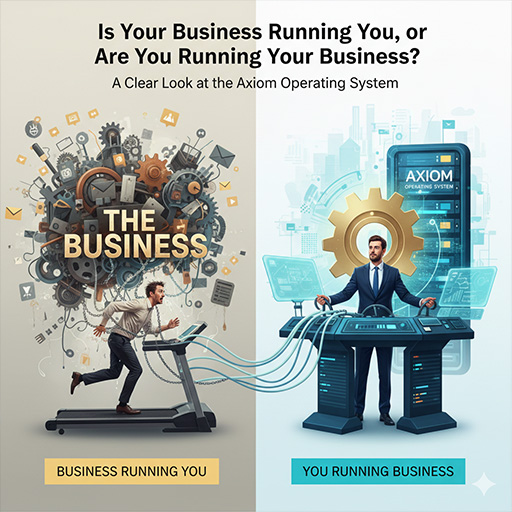
Is Your Business Running You, or Are You Running Your Business? A Clear Look at the Axiom Operating System
Most founders I talk to feel the same steady weight.
They are working harder than ever, yet the business still feels heavy. Decisions take too long. The team is not fully aligned. Problems keep resurfacing in different forms.
It feels like juggling a hundred issues at once.
In reality, it is rarely a hundred issues. It is usually six.
The Axiom Operating System is built on a simple idea. Every business, regardless of size or industry, operates through six core areas. When those areas are weak, complexity grows. When they are strong, the business starts to breathe again.
AI does not replace leadership here. It sharpens it.
Below is the framework, grounded in how real operators experience it, with practical context on how AI can support each area.
1. Direction
Most founders have direction. It lives in their head.
That is the problem.
When direction is not clearly shared, teams fill in the gaps themselves. Priorities blur. Meetings wander. Execution becomes inconsistent.
The Direction component forces clarity around where the business is going, what it stands for, and what actually matters right now. Not slogans. Real decisions.
AI can help translate founder intent into clear, simple language the team understands. It can review plans, meeting notes, and internal communication to surface misalignment early, before it turns into confusion or wasted effort.
AI does not set direction. It helps ensure it is actually understood.
2. Team Alignment
A clear direction with the wrong people still fails.
Team Alignment is about values fit and role fit. You need people who align with how the business operates and who are suited for the seats they occupy.
When either side is off, performance issues turn personal. Culture erodes quietly.
AI can support objective evaluation by identifying patterns in performance, feedback, and workload. It helps leaders see misalignment sooner instead of relying solely on gut feel or hoping things improve on their own.
AI will not make the hard call. It removes the fog around it.
3. Scorekeeping
Many founders run their businesses on instinct longer than they should.
Instinct helps you start. It eventually limits you.
Scorekeeping creates a short list of numbers that tell the truth about the business. Not lagging reports. Leading indicators that show where things are headed.
AI is especially useful here. It can pull data from multiple systems, identify trends, and flag anomalies early. This allows leaders to predict outcomes instead of reacting to surprises.
This is where businesses move from emotional to intentional.
4. Problem Solving
Every business has problems.
Struggling businesses avoid them. Healthy businesses surface and resolve them.
The Problem Solving component builds a culture where issues are raised quickly, discussed honestly, and addressed at the root instead of patched over.
AI can analyze meeting notes, customer feedback, operational delays, and internal communication to reveal recurring patterns. It helps teams recognize the real issue rather than repeatedly treating symptoms.
AI does not solve the problem. It helps you stop missing what the problem actually is.
5. Execution Playbooks
This is where many founder-led businesses quietly hit a ceiling.
When processes live in people’s heads, consistency depends on heroics. The business works because certain individuals carry it.
That is fragile.
Execution Playbooks document how the business actually runs in a simple, usable way. This creates consistency without bureaucracy and allows the business to scale without burning people out.
AI can capture tribal knowledge, organize it into clear playbooks, and keep documentation current as the business evolves. It turns what only a few people know into something the entire organization can execute.
This is how the business becomes less dependent on any one person.
6. Momentum
Clear plans without follow-through go nowhere.
Momentum creates focus and accountability. Short-term priorities are defined. Ownership is clear. Progress is reviewed regularly.
Work starts moving forward instead of sideways.
AI can track commitments, monitor progress, and surface risks early. It helps leaders maintain discipline without micromanaging and keeps priorities from getting buried under daily noise.
Momentum stops being accidental.
The Bottom Line
The Axiom Operating System is not about adding complexity. It is about simplifying the business into six manageable areas.
AI does not replace leadership, judgment, or accountability. It reinforces clarity, consistency, and speed.
When these six areas are strong, most of the friction disappears. Founders stop feeling trapped inside the business they built. Control returns. The company starts working for them again.
That is the shift that matters.